

Free to register
It starts innocently.
You ask Claude its opinion on something. You double-check its answer, click on all the links, run the maths through a calculator — you know AI often gets it wrong. But the answer is good. You proceed.
The next time, your review is slightly less robust. After all, Claude nailed it last time, right? So you gut-check it, seems ok, move on.
Soon, you’re not even bothering with the gut check.
You’ve turned over all your thinking to the AI.
Maybe this would never happen to you. But it’s definitely happening to the people around you.
A landmark study from the University of Pennsylvania found that people follow faulty AI recommendations roughly four out of five times, a phenomenon the researchers call "cognitive surrender." What does this mean for how we make decisions, and what can we do about it?
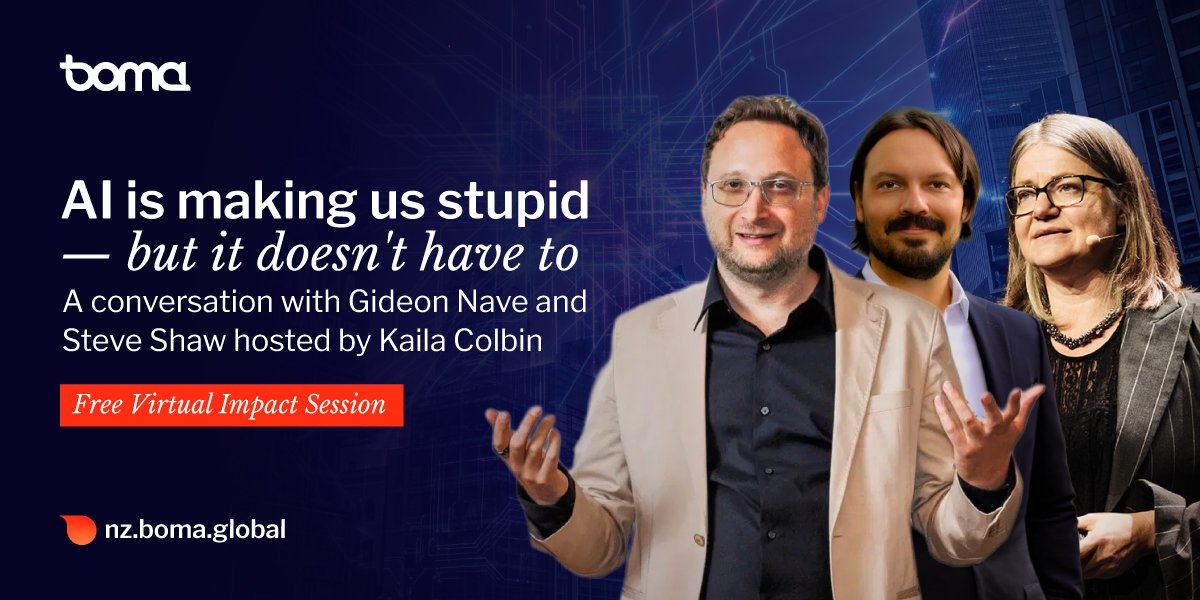
Join University of Pennsylvania researchers Steve Shaw and Gideon Nave — the authors behind this groundbreaking research — in conversation with Boma founder and CEO Kaila Colbin, to unpack what their findings reveal about human reasoning in the age of AI, and what it means for individuals and organisations navigating an AI-saturated world.
Don't miss this essential conversation for anyone who wants to think more critically about how AI is reshaping the way we think.
When: 8–9 a.m. Friday, 24 April NZT (find your local time here)
Where: Virtual, via Zoom
Register for this free session:
This event will be live closed captioned and includes a live Q&A at the end of the webinar.
About Steve Shaw
Steve Shaw is a Postdoctoral Researcher in Marketing at the Wharton School of the University of Pennsylvania. His research explores how emerging technologies and novel data types, such as genomics, generative AI, and neuroscience, are redefining contemporary challenges in marketing.
He holds a PhD in Marketing and an MA in Statistics from the University of Michigan.
About Gideon Nave
Gideon Nave is an Associate Professor of Marketing at the Wharton School. His research draws on quantitative and experimental methods from computational neuroscience, cognitive psychology, game theory, and machine learning to reverse-engineer how humans make decisions, and has been published in leading journals including Science and the Proceedings of the National Academy of Sciences.
He holds a PhD in Computation & Neural Systems from Caltech.
If you have any questions about this event, please email us on [email protected].
